
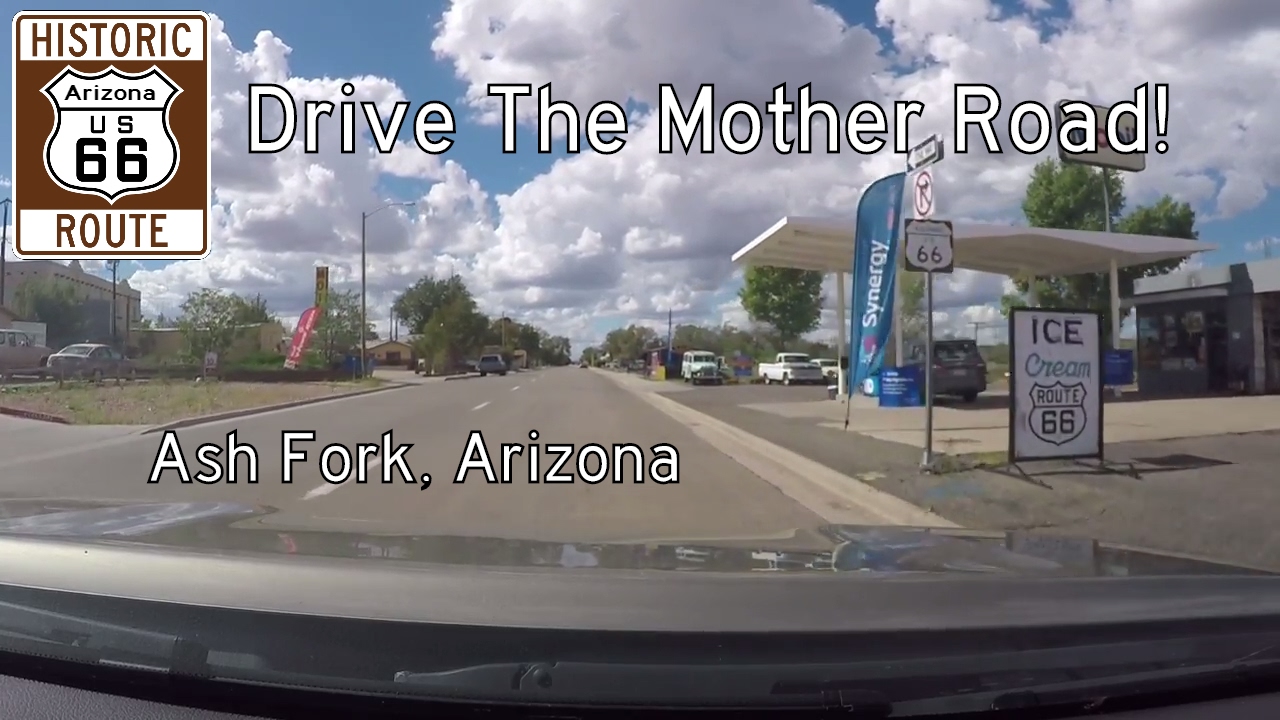
Take a scenic ride through the high desert of northern Arizona as we follow a short but culturally rich stretch of Historic Route 66 through Ash Fork, a town that proudly wears its Route 66 legacy like a badge of honor. Though only two miles long, this segment captures a crossroads of rail, road, and rugged history, tucked into the foothills just south of the Kaibab National Forest and within striking distance of the Grand Canyon.
We begin our journey on the eastern edge of Ash Fork where Historic Route 66 still traces its way through town—primarily along Park Avenue heading west, and Lewis Avenue as we loop back east. The two streets form a loop that once bustled with travelers heading to Los Angeles or Chicago, their windshields reflecting neon signs and chrome trailers. Today, the rhythm is slower, but echoes of the road’s heyday linger. Park Avenue, in particular, holds onto its mid-century Americana, lined with a mix of still-operating businesses like the Oasis Lounge and nostalgic remnants like vintage motels and shuttered cafes. False-front buildings and modest railroad-era houses remind us that Ash Fork predates Route 66 by decades—it was originally a siding for the Atlantic and Pacific Railroad and later a key junction on the Santa Fe mainline.
Crossing the Union Pacific tracks, we glide down Lewis Avenue, the quieter twin of Park. This was once a key corridor for locals and travelers alike, and though time has worn away the gloss, there’s something grounding in the grit. Ash Fork has seen booms and busts—fires, floods, and freeway bypasses. And yet it still endures. Perhaps nothing encapsulates the town’s resilience quite like the fact that it was chosen as a filming location for Universal Soldier (1992). With property values at rock bottom and some buildings barely standing, producers used the town’s authenticity to their advantage, even blowing up an old motel for one of the film’s sequences. It’s a strange badge of honor—but in Ash Fork, that’s just another chapter in its long, unpredictable story.
As we head out of town to the west, we pass by sparse signage pointing toward Beale Road, about 15 miles north—a dirt track that once carried Lt. Edward Beale’s Camel Corps expedition in the 1850s and later became one of the very first federally funded wagon routes. This area is steeped in transportation history, and nowhere is that more obvious than just beyond the town limits. Stretching from Ash Fork to Seligman is the longest uninterrupted original alignment of Route 66 still drivable. Unspoiled by modern bypasses or realignment, this stretch remains largely unchanged since the 1920s. It’s a pilgrimage for many—a drive through time, with rusting service stations and aged billboards acting as waypoints into the past.
While our official route through Ash Fork may be brief, it’s densely layered. This is where road history, rail history, and desert tenacity converge. Ash Fork might not have the glamour of Santa Monica or the crowds of Winslow, but it has something else—roots. A sense of place. A story written in soot, cinders, and sunbaked blacktop. It reminds us that not every chapter of Route 66 is lined with neon and polished diners—some chapters are quieter, but just as vital.
🎵 Music:
Piano March by Audionautix is licensed under a Creative Commons Attribution license (https://creativecommons.org/licenses/by/4.0/)
Artist: http://audionautix.com/
🗺️ Route Map

0 Comments